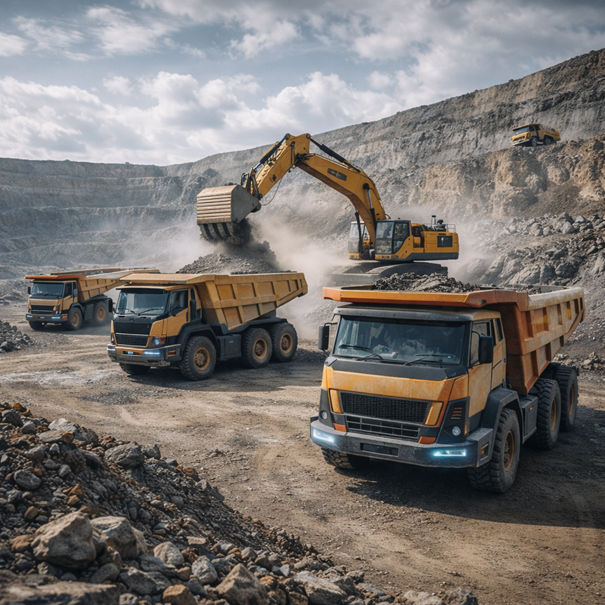
At the “REAL MINING 2025” conference, Alexander Netid, Head of Product Development at LiuGong Machinery Rus, delivered a presentation titled “The Global Market and Local Strategies: How Demand for Mining Equipment Is Changing in Russia.”
1. Chinese equipment is becoming heavier
Until 2022, LiuGong did not supply super-heavy equipment to Russia. At that time, the maximum operating weight of excavators reached 90 tons. Nevertheless, as Alexander Netid emphasized, even then the company had competitive offerings for customers.
Chinese manufacturers are rapidly adapting and expanding their product portfolios. “Today, we have already announced 200-ton excavators, as well as heavy loaders, dump trucks, and bulldozers,” the expert added.
2. Manufacturers are preparing for next-generation technologies
As early as 2026, LiuGong plans to introduce a broad lineup of electric machinery. The company understands that promoting such equipment in Russia will not be easy, as several challenges related to electric drive operation in harsh climatic conditions must be addressed. “However, we already have certain successes,” Alexander Netid noted, adding: “Those who remember the Soviet Union will likely say this is not something new, but rather a well-forgotten old practice. In Soviet times, the level of electrification in mining operations was much higher than it is today.”
3. The shortage of personnel remains an issue
In addition, the professional skill level of personnel is declining. The solution lies in implementing intelligent control systems, including monitoring systems and smart operator-assistance technologies.
When mining equipment is equipped with remote monitoring systems, it becomes possible to track the machine’s technical condition in real time. Malfunction reports can even include stoppages caused by issues such as clogged filters.
4. The search for new, unconventional solutions
One example is the successful replacement of heavy bulldozers with excavators equipped with rippers in certain regions of Russia. According to Alexander Netid, this approach requires partial restructuring of production processes, but in some cases proves to be more efficient.
5. Service must meet the standards of departed brands
European suppliers have left behind an important legacy in the form of high service standards. This places obligations on dealers of Chinese brands as well. “We cannot come in with our own rules and say that everything will now be different. Customers are accustomed to a high level of quality. Therefore, round-the-clock service, spare parts availability, and professional service personnel are essential—without these, no one will even start a conversation with us,” the speaker emphasized.
It is also important to demonstrate to customers that Chinese equipment is not experimental or one-off units, but fully fledged mass-produced machines assembled from clearly defined components. Comprehensive information is available for these components, including where, when, and how they were manufactured, as well as their availability in warehouses.
1. Chinese equipment is becoming heavier
Until 2022, LiuGong did not supply super-heavy equipment to Russia. At that time, the maximum operating weight of excavators reached 90 tons. Nevertheless, as Alexander Netid emphasized, even then the company had competitive offerings for customers.
Chinese manufacturers are rapidly adapting and expanding their product portfolios. “Today, we have already announced 200-ton excavators, as well as heavy loaders, dump trucks, and bulldozers,” the expert added.
2. Manufacturers are preparing for next-generation technologies
As early as 2026, LiuGong plans to introduce a broad lineup of electric machinery. The company understands that promoting such equipment in Russia will not be easy, as several challenges related to electric drive operation in harsh climatic conditions must be addressed. “However, we already have certain successes,” Alexander Netid noted, adding: “Those who remember the Soviet Union will likely say this is not something new, but rather a well-forgotten old practice. In Soviet times, the level of electrification in mining operations was much higher than it is today.”
3. The shortage of personnel remains an issue
In addition, the professional skill level of personnel is declining. The solution lies in implementing intelligent control systems, including monitoring systems and smart operator-assistance technologies.
When mining equipment is equipped with remote monitoring systems, it becomes possible to track the machine’s technical condition in real time. Malfunction reports can even include stoppages caused by issues such as clogged filters.
4. The search for new, unconventional solutions
One example is the successful replacement of heavy bulldozers with excavators equipped with rippers in certain regions of Russia. According to Alexander Netid, this approach requires partial restructuring of production processes, but in some cases proves to be more efficient.
5. Service must meet the standards of departed brands
European suppliers have left behind an important legacy in the form of high service standards. This places obligations on dealers of Chinese brands as well. “We cannot come in with our own rules and say that everything will now be different. Customers are accustomed to a high level of quality. Therefore, round-the-clock service, spare parts availability, and professional service personnel are essential—without these, no one will even start a conversation with us,” the speaker emphasized.
It is also important to demonstrate to customers that Chinese equipment is not experimental or one-off units, but fully fledged mass-produced machines assembled from clearly defined components. Comprehensive information is available for these components, including where, when, and how they were manufactured, as well as their availability in warehouses.